
Modern surgery depends on tools that respond quickly while providing surgeons with controlled performance in increasingly compact systems. Equipment often needs to function through small incisions or operate within narrow pressure ranges. Those demands place strict requirements on the components inside each device.
Solenoids support many of these functions because they convert electrical input into controlled mechanical motion. Their compact size and fast response make them useful in equipment that must act on command without bulky mechanisms. In surgical systems, that capability can support fluid control and precise mechanical actuation.
The following surgical tools and support systems show how solenoid technology can contribute to controlled performance in the operating room.
1. Laparoscopic Insufflators
Minimally invasive abdominal surgery often requires an insufflator to deliver carbon dioxide into the abdominal cavity. The gas creates working space, allowing a surgeon to view tissue and maneuver instruments through small access points.
Inside the insufflator, solenoid valves can regulate gas flow and help the system respond as pressure changes during a procedure. Fast switching allows the equipment to adjust delivery without relying on large mechanical assemblies. Proportional control can also support smooth changes in gas flow when the device needs more than simple on-and-off operation.
Engineers must balance response speed, heat generation, internal volume, and flow capacity when they select components for an insufflation system. A compact valve can help designers reduce overall system size while supporting the pressure control the application requires.
2. Surgical Suction Systems
Surgical suction equipment removes blood, irrigation fluid, and debris from the operating field. Some systems also help manage smoke or aerosols that appear during electrosurgical procedures.
Solenoid-controlled fluid paths can start, stop, or redirect suction as the system receives commands from the user interface. Rapid actuation helps the equipment respond quickly when the surgeon or operating room staff changes a setting.
Designers may also use solenoid technology to isolate flow paths or switch between suction functions. The right configuration can reduce moving parts while giving the control system a direct electrical way to manage fluid movement.
3. Robotic Surgical Instruments
Robotic surgery places a premium on repeatable movement and compact component design. Surgical robots translate the surgeon’s hand motions into instrument movement inside the patient, often through narrow ports.
A solenoid can provide short, controlled linear motion for locking mechanisms or release functions. Engineers can also use that motion to reposition internal mechanisms. They can design the stroke length and force around a specific task rather than using an oversized motor for every action.
Solenoids can also work alongside motors and mechanical linkages. In that role, the solenoid handles a discrete function while the motor performs continuous positioning. This division can simplify the mechanism and reduce the space required for secondary actions.
4. Powered Stapling Systems
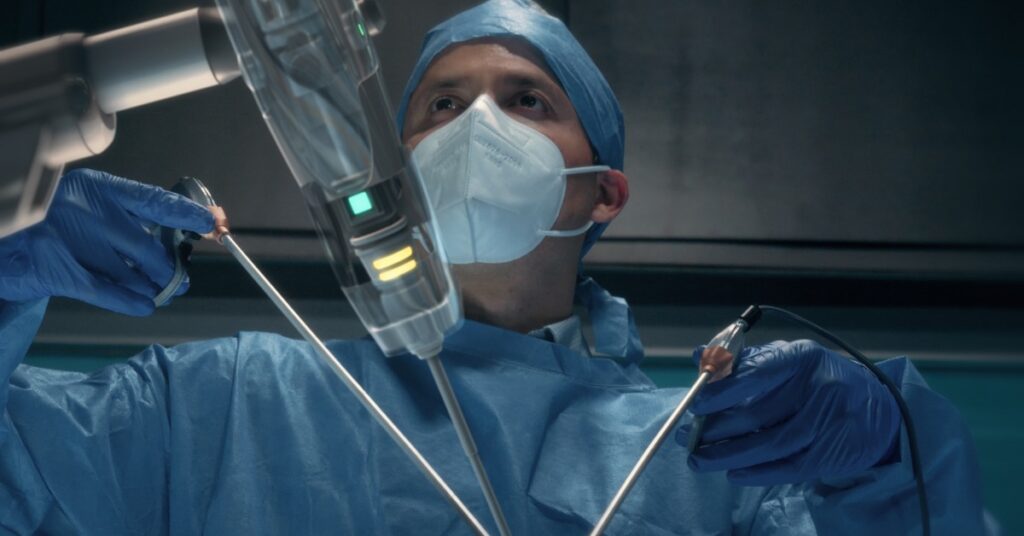
Powered surgical staplers must coordinate mechanical functions with tight timing. Depending on the design, the instrument may clamp tissue, fire staples, cut tissue, or release the jaw after the firing cycle.
A solenoid can support locking or release functions within the handle or drive system. Because the device can energize the coil only when it needs movement, designers can use electrical control to coordinate the action with sensors and other electronics.
The mechanical load may change throughout the cycle, so engineers must match force output to the point where the mechanism sees the greatest resistance. Stroke length, duty cycle, coil temperature, and available power all influence component selection.
5. Electrosurgical Handpieces
Electrosurgical tools use electrical energy to cut tissue or control bleeding. Many handpieces include buttons, triggers, valves, or internal mechanisms that let the user switch operating modes.
A compact solenoid can create a crisp mechanical response when the control system needs to engage an internal feature. For hand-held equipment, designers must keep weight and size low because small increases can affect ergonomics during long procedures.
Low power use can also become important when the tool draws energy from a limited electrical system. Careful coil design helps engineers balance force with heat and available space. The best configuration depends on how often the mechanism cycles and how long it stays energized.
6. Surgical Irrigation Equipment
Irrigation systems deliver sterile fluid to clear tissue or wash a surgical field. The equipment may need to switch flow quickly as the surgeon alternates between irrigation and suction.
Solenoid-operated flow control gives the device an electrical method for opening or closing a fluid path. Engineers can place the valve near the point of use to reduce tubing volume and sharpen system response.
Material compatibility also plays a major role in the design. Internal components may contact saline or other medical fluids, so engineers must choose valve materials that suit the intended medium and cleaning requirements. A media-separated design can keep the working fluid away from selected actuator components.
7. Pneumatic Surgical Tools
Some surgical tools use compressed air to generate movement while electrical controls manage when that movement occurs. Pneumatic cutters, drills, and other powered instruments can rely on valve systems that route air to the correct part of the mechanism.
A solenoid-controlled valve can act as the electrical interface between the device controls and the pneumatic circuit. When the control system sends a signal, the valve changes the air path and triggers the requested action.
Compact dimensions become especially valuable when engineers integrate pneumatic controls into a handpiece or small console. Fast response can also improve the connection between user input and tool movement.

8. Endoscopic Systems
Endoscopic procedures often combine imaging with irrigation, suction, insufflation, or accessory control. Each added function increases the number of fluid and mechanical paths that designers must manage inside limited space.
Solenoids can control small valves or mechanical features without requiring the user to operate a separate manual mechanism for every function. This approach allows designers to connect physical actions directly to buttons, pedals, or software commands.
For systems that manage gas and liquid, engineers may choose different valve designs for each flow path. Pressure range, allowable leakage, media compatibility, and switching speed can guide those decisions. Small internal volumes can also help the system react quickly when flow conditions change.
9. Surgical Laser Cooling Systems
Surgical lasers generate heat, and many systems use air or liquid cooling to protect components and maintain stable operating conditions. Cooling circuits may need to open only when the laser operates or when sensors detect a temperature change.
Solenoid technology can control coolant or air flow based on signals from the system electronics. The valve can respond quickly without requiring a technician to adjust the circuit manually during use.
Engineers must account for flow rate, pressure, fluid compatibility, and duty cycle when they design the cooling path. Reliable actuation helps the thermal management system react consistently as operating conditions shift.
Building Better Surgical Equipment
Solenoids rarely attract attention in the operating room, but they can perform critical control functions inside equipment that surgeons use every day. They can open a gas path or trigger a locking mechanism. Other designs use them to control fluid movement with a compact electrical input.
For medical device engineers, the challenge lies in matching the solenoid to the exact mechanical or fluid-control requirement. Force, stroke, heat, available space, power consumption, and media compatibility can shape the final design.
A well-matched solenoid gives surgical equipment designers another way to create responsive systems without adding unnecessary mechanical complexity. As surgical tools become smaller and more integrated, compact electromechanical control will continue to support the precise functions those tools demand.